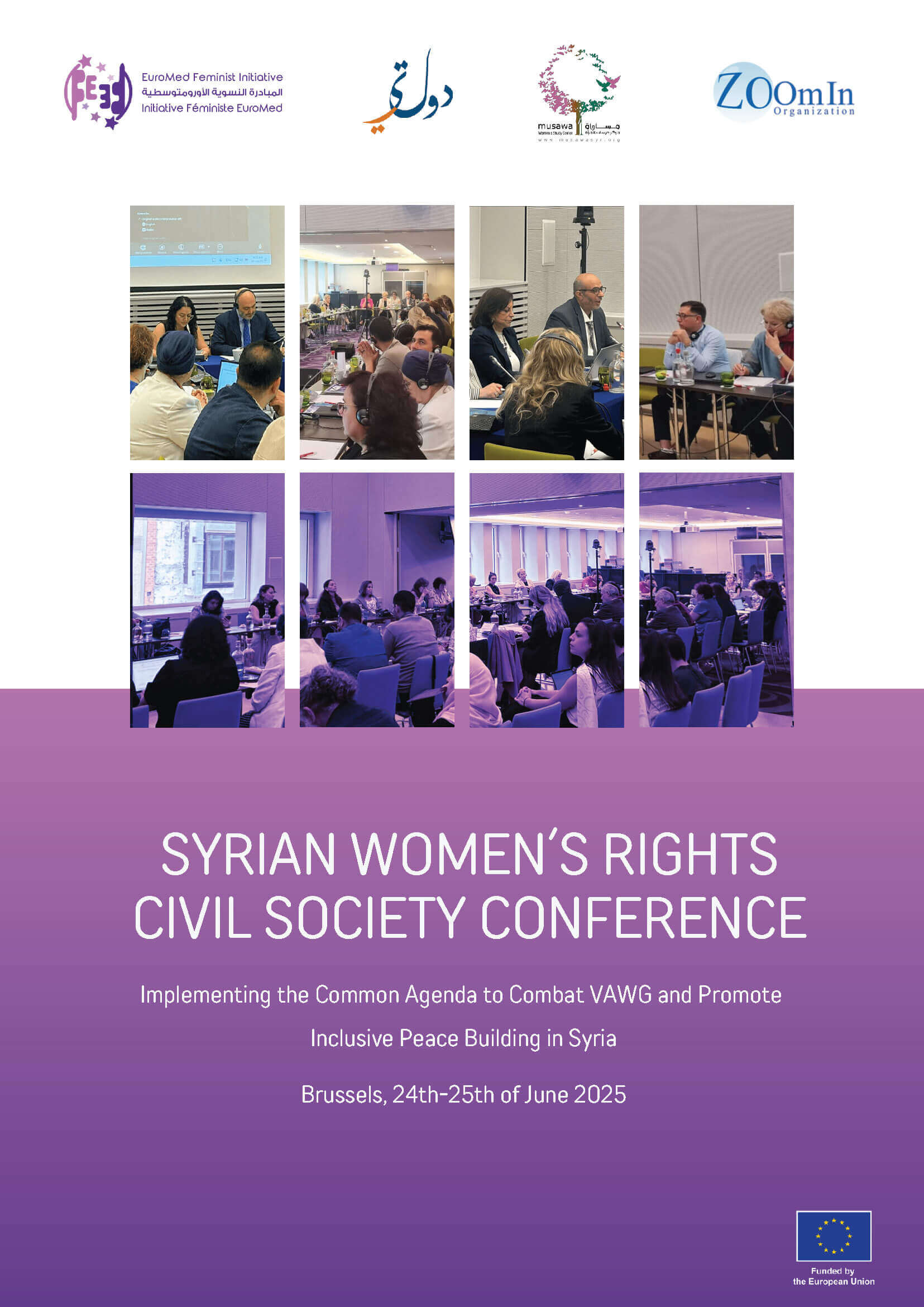
The Second Syrian Women’s Rights Civil Society Conference, titled “Implementing the Common Agenda to Combat Violence Against Women and Girls and Promote Inclusive Peacebuilding in Syria,” was held on 24–25 June 2025 in Brussels. The conference was organised within the framework of the project “Implementing the Common Agenda to Combat Violence Against Women and Girls and Promote Inclusive Peacebuilding Processes in Syria,” implemented by EuroMed Feminist Initiative (EFI) in partnership with Musawa, Dawlaty, and Zoom In, and funded by the European Union. The event convened more than 60 Syrian and international stakeholders, including representatives from the European Union, the European Parliament, the Office of the United Nations Secretary-General’s Special Envoy for Syria, and various international organisations. Participants reaffirmed the central role of women and women’s rights in Syria’s reconstruction and in advancing a democratic, peaceful, and equal future.
Violence against women and girls is a complex and deeply rooted issue influenced by social, cultural, legal, and political factors. The persistence of discriminatory laws and prevailing social norms continues to limit women’s rights and freedoms. Many forms of violence — including domestic violence, early and forced marriage, sexual harassment, and economic violence — are widespread and often go underreported. This policy brief aims to provide a comprehensive overview of the current situation of violence against women and girls in Iraq and the Kurdistan Region of Iraq (KR-I), highlighting the legal and policy frameworks, identifying existing gaps, and offering practical recommendations to strengthen prevention, protection, and response mechanisms. It draws on evidence from national data, civil society reports, and international standards to support decision-makers and stakeholders in promoting equality and combating violence.
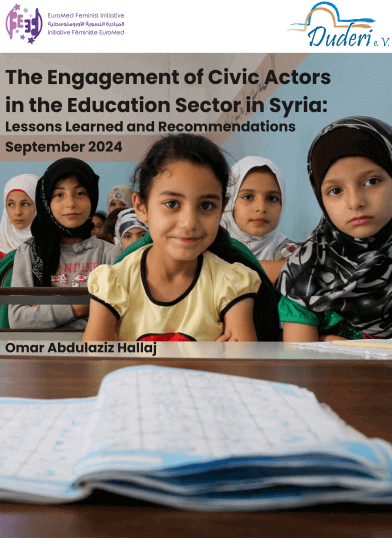
This policy paper was developed to draw lessons learned from a detailed research initiative conducted by Duderi to map the role of civic actors in the education sector in Syria. The research provided an in-depth review of conditions in six regions, covering local circumstances across all zones of political control that have emerged during the conflict. This policy paper aims to synthesize the key lessons learned from the research and offers targeted and actionable recommendations to key stakeholders.
This brief seeks to shed light on sexual harassment in the workplace in Jordan, highlighting it as a serious problem affecting women. It can have a devastating impact on women victims, both personally and professionally. The brief focuses on the legal framework, analyzing the factors that enable sexual harassment in the workplace and the barriers to reporting it.
The brief is based on the outcomes of studies conducted by Equal Citizenship Centre (ECC) between 2017 and 2021, as well as of consultative discussions held between 2023-2021 during several expert roundtables that gathered over 35 Syrian legal experts and 40 gender and women ́s rights experts from over 20 civil society organizations (CSOs) working on combating VAWG in Syria.
Examining the needs and concerns of women, who represent more than half of the workers in the informal economy, and the number of multi-layered challenges they face, this policy brief recommends applying a comprehensive, gender sensitive approach in formalizing the informal economy which ensures the protection of women’s labour and financial rights. Recommendations are drawn for the different relevant actors, including women in the informal economy themselves as both workers and owners of small and medium businesses, governmental actors and decision makers, as well as civil society.
For combating Violence against Women and Girls (VAWG), interventions fall along a spectrum of prevention and response. While VAWG response efforts typically focus on securing services, resources, and support for women victims of VAWG, prevention interventions focus on transforming the power dynamics and gender inequality leading to VAWG. This brief deals with governmental preventive programs that are meant to change the gender stereotypes, people’s awareness towards VAWG and towards blaming perpetrators.
The joint agenda for combating violence against women and girls, as a major obstacle to women's participation in Syria, serves as a tool for advocating for the structural access of Syrian women to decision-making at local, national, and international levels. It is also a means of encouraging the inclusion of women's rights in all decision-making plans and policies related to the political transition to democracy in Syria. The joint agenda is also considered a tool for raising broader awareness about violence against women and girls, its devastating impact on women, and how it is used to prevent women from participating publicly and politically. The joint agenda was developed through a year-long consultative process.

The Common Agenda for Combating Violence against Women and Girls as a major barrier to women’s participation in Syria is a tool to advocate for structural access of Syrian women to decision-making on local, national, and international levels. It is also a means to urge for the inclusion of women´s rights in all decision-making and policy agendas linked to political transition towards democracy in Syria. The Common Agenda is also a tool to raise broader awareness about violence against women and girls, its devastating effect on women and how it is used to prevent women from public and political participations. The Common Agenda was developed through a year-long consultation process with over 250 Syrian activists, gender, and legal experts from over 100 organisations and initiatives, as part of the program "Enhancing women's participation in decision-making and peace-building processes in Syria" funded by the European Union.
The Regional Observatory on VAWG, hosted by EuroMed Feminist Initiative (EFI), has the pleasure to share with you the latest policy brief titled “Public Services for Women Victims of VAWG.” The brief discusses the critical public services available to women who have been victims of violence. It is based on the findings of a regional research done by the Regional Observatory in 2020, which focused on women's perceptions and awareness of victim services. The brief also relies on the 2020 Regional Index on VAWG. It illustrates the state of health, police, and justice services, as well as social services, considering best practices and international accords, particularly the Convention on Preventing and Combating Violence against Women and Domestic Violence (Istanbul Convention). The brief first draws upon the standards for service provision and how essential services should be provided. Additionally, it discusses the state of the services in the countries observed (Algeria, Egypt, Jordan, Lebanon, Morocco, Palestine, Tunisia) and offers policy recommendations to enhance them.
This summary highlights the areas of combating violence against women and girls and focuses on the necessary legal reform to prevent and address this violence. The analysis of the situation of violence against women and girls presented in this summary is based on the exploratory study conducted in 2020 by the Regional Observatory of Civil Society Organizations, as well as on the indicator of violence against women and girls. The summary also synthesizes the study and its findings regarding legislation. It aims to provide recommendations to governments to improve laws based on informed decisions and to civil society organizations to advocate for change and contribute to it. In order to combat violence against women and girls, the summary recommends reforming the legal framework by removing discriminatory provisions and adopting a specific and comprehensive law on violence against women and girls, which addresses all forms of violence as defined in United Nations legal and policy instruments, and is comprehensively criminalized. This law should also ensure prevention, protection, remedies, and care for survivors of violence, prosecute perpetrators, and provide for cooperation among relevant parties, as well as data collection. The adoption of a specific and comprehensive law is essential to combat violence against women and girls, as it provides legal means for women and girls against all forms of violence they may face, and also guides the reform of the entire legal framework.
This brief sheds light on areas of combating violence against women and girls (VAWG) and focuses on legal reform needed to prevent and combat it. The analysis for the situation of VAWG provided in this brief is based on the explorative study1 conducted by the Regional Observatory in 2020 and the regional index on VAWG. The brief summarises the study and its findings pertaining to legislation. The brief is intended to provide recommendations to governments to improve the laws based on informed decisions and to Civil Society Organisations (CSOs) to advocate and contribute to the change. To combat VAWG, the brief recommends reforming the legal framework by removing discriminatory articles and adopting a specific and comprehensive law on VAWG in which all forms of violence are mentioned as defined in United Nations legal and policy instruments and are comprehensively criminalised.
Under the patronage of the Judicial Council of Kurdistan Region of Iraq (KR-I), Women Empowerment Organization (WEO) in partnership with EuroMed Feminist Initiative (EFI) organized an Experts’ Roundtable on November 17th, 2021 in Erbil “Gender Discrimination in Laws and Protecting Women and Girls from Violence”, marking the global campaign on 16 Days against Violence against Women and Girls (VAWG). The roundtable gathered representatives from Kurdistan’s Region Judicial Council, members of the Kurdistan Parliament, governmental stakeholders, legal experts, women rights organizations and gender experts.
The Lebanese constitution specifies that “All Lebanese shall be equal before the law…”, yet discrimination against women is pervasive throughout Lebanon’s legal framework. Moreover, Lebanon has ratified several important international agreements including the Convention on the Elimination of All Forms of Discrimination Against Women (CEDAW) and the Convention on the Rights of the Child (CRC), yet inequality is entrenched within the legal system evident in the presence of overtly discriminatory legal provisions, absence of specific protections, the use of discriminatory practices in the implementation of laws and the influence of religious institutes.
In terms of educational level of the populace, Lebanon is among the most literate countries in the area, with 99% literacy among both women and men. However, enrolment and retention rates across the different levels are not as elevated and show disparities between genders more specifically in secondary and higher education. As shown in the below table the enrolment rate is almost equal between both gender in KG, Cycle 1 and 2, while in Cycle 3 and 4 there is a gender gap with more girls attending schools than boys. This is particularly true for non-Lebanese. While these numbers show progress and a high level of enrolment for girls, the social culture (patriarchal and stereotypical) still inhibits some girls from participating in the education system. More specifically, girls from poor and less fortunate families are still considered a burden and are married off at an early age. This is further enhanced in the LCRP Education chapter, which highlights the fact that vulnerable and marginalized families resort to negative coping mechanisms when faced with financial hardships that includes supporting boys’ education over girls. To view original source, click the following link: https://www.nationalgenderobservatory.org/en/research