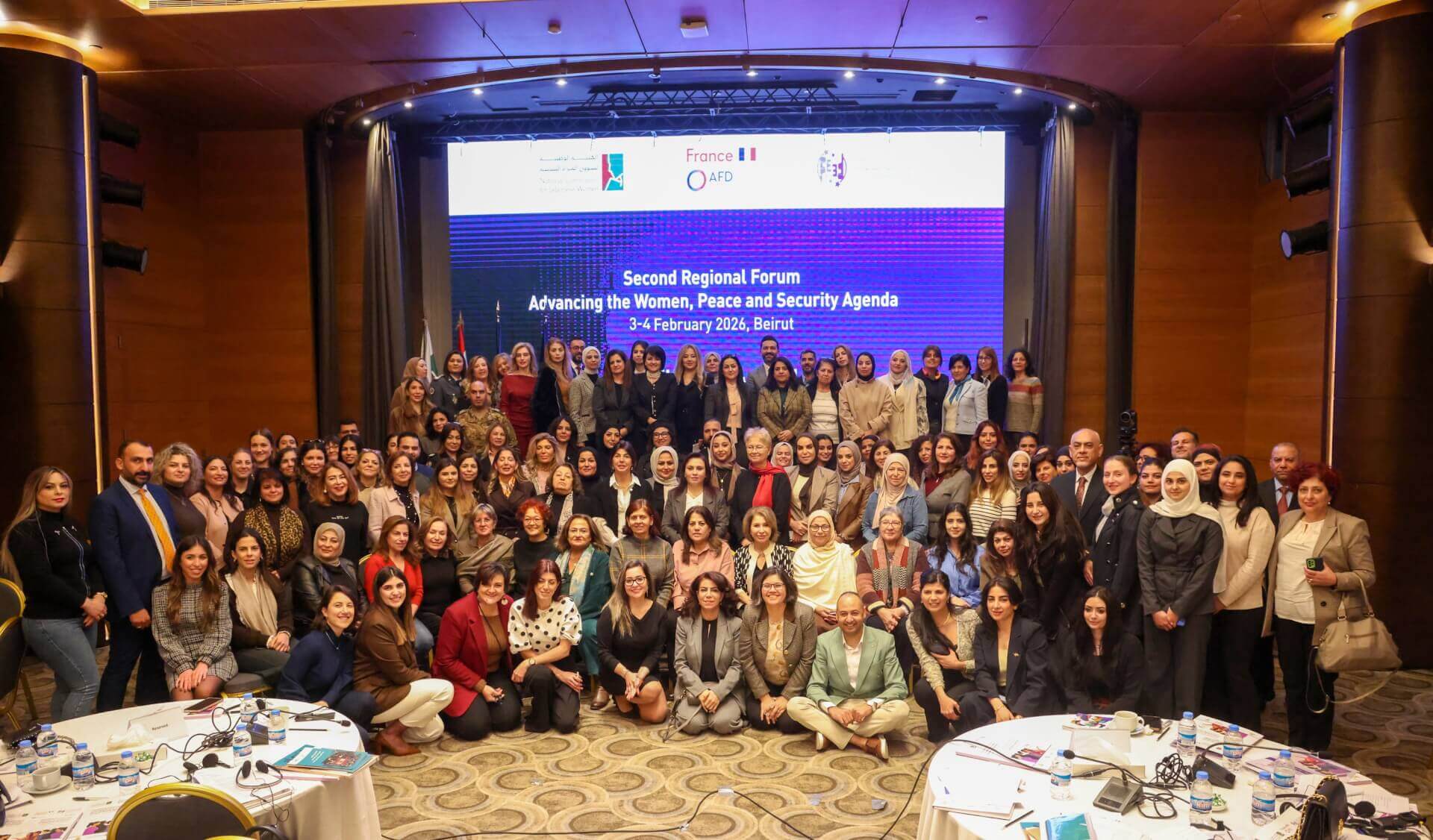
The Second Regional Forum on Advancing the Women, Peace and Security Agenda (WPSA)
2026-02-02T21:00:00Z - 2026-02-03T21:00:00Z
Beirut, Lebanon
The Second Regional Forum “Advancing the Women, Peace and Security Agenda” took place on 3–4 February 2026 in Beirut, organised by the National Commission for Lebanese Women (NCLW) and EuroMed Feminist Initiative. The Forum was held within the framework of the regional project “Strengthening Feminist Civil Society Organisations for the Implementation of the Women, Peace and Security Agenda in Iraq, Lebanon, Jordan and Palestine,” funded by the Support Fund for Feminist Organisations of the Agence Française de Développement (AFD) and the French Ministry for Europe and Foreign Affairs.
The Forum opened with welcoming remarks that reflected a clear institutional and political commitment to advancing the implementation of the Women, Peace and Security Agenda (WPSA) at both national and regional levels. In her opening remarks, lawyer Nathalie Zaarour, Executive Board Secretary of the NCLW, noted that the Forum was being held against the backdrop of complex regional and global conditions, marked by intersecting political, economic, social, and security crises, which pose real challenges to the effective implementation of the WPSA. She also highlighted that the Forum provides an opportunity for a serious review of implementation mechanisms at national and regional levels, contributing to the rebuilding of governance and security systems on the basis of gender equality and laying the groundwork for more inclusive and sustainable peace.
For his part, H.E. Mr Hervé Magro, Ambassador of France to Lebanon, reaffirmed France’s continued commitment to supporting the WPSA. He underlined the importance of supporting and building the capacities of feminist civil society organizations (CSOs) to combat violence, solve conflicts and provide protection and prevention services during crises. H. E. highlighted the need to promote dialogue, cooperation and trust building between civil society, governments and international actors.
Ms. Lilian Halls French, Co-President of EuroMed Feminist Initiative, highlighted that the work of civil society is essential before, during and after conflict. She reminded that building on the outcomes of the First Regional Forum held in Amman in May 2025, the Second Regional Forum aimed to promote constructive dialogue among diverse stakeholders, facilitate the exchange of experiences, and make links between the implementation of the WPSA with key concerns including, climate justice, cyber violence, transitional justice and accountability, as well as discuss challenges linked to funding of the implementation of the WPSA.
Approximately 160 participants from Lebanon, Iraq, Jordan and Palestine took part in the Second Forum, including representatives of CSOs and CBOs, relevant stakeholders and governmental institutions involved in the implementation of the WPSA, women’s rights and legal experts and academics, as well as representatives of international donors, embassies, United Nations agencies, and the media. The Forum also welcomed guests from Syria, Algeria and Norway, to exchange their experiences and reflect on the status of the WPSA.
Over the two days, discussions focused on State commitments to the WPSA, the role of feminist civil society in advancing protection, resilience, and community-led initiatives, as well as the responsibilities of the international community in sustaining the implementation of the WPSA. Diversity of speakers – from national stakeholders coming from the NCLW, the President office and General Secretariat of the Council of Ministers of Iraq, General Directorate for Combating Violence against Women and the Family, at Ministry of Interior in Kurdistan Regional Government, Ministry of Social Development of Jordan, the Jordanian National Commission of Women (JNCW), the National Council for Family Affairs (NCFA) to civil society representative and international donors and UN Women, Lebanon - addressed cross-cutting priorities related to the WPSA, including technology-facilitated gender-based violence (TFGBV) and cyber violence, climate justice and environmental insecurity, gender-sensitive transitional justice and reconstruction, and women’s economic security, with particular attention to the inclusion of women with disabilities, refugees and IDPs. All of them, in their diversity, inspired lively discussions though plenary sessions, open discussions and four thematic workshops.
Participants exchanged experiences, identified challenges and good practices, and formulated practical policy recommendations to strengthen the implementation and monitoring of the WPSA at both national and regional levels in connection with the emerging developments.
The outcomes of the Forum will be documented and disseminated to relevant stakeholders, in order to contribute to more inclusive, coherent, and accountable implementation of the WPSA across the region, and wider.