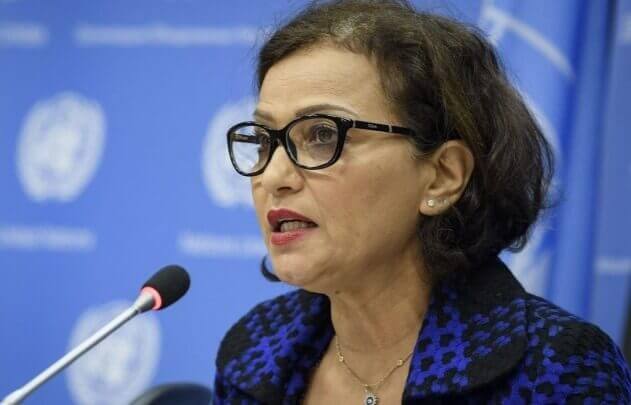
H.E. Najat Rochdi
Deputy Special Envoy of the UN Secretary-General for Syria
Opening remarks on the occasion of the
Syrian Women’s Rights Civil Society Conference
“Implementing the Common Agenda to Combat VAWG and Promote Inclusive Peace Building in Syria”
by
H.E. Ms. Najat Rushdi
Deputy Special Envoy of the Secretary-General of the United Nations to Syria
24th–25th of June 2025 – Brussels
Ladies and Gentlemen, colleagues and dear Syrians,
As we all know, Syrian women do not comprise one entity with a singular vision. Opinions and visions for Syria’s future are unsurprisingly diverse. But throughout the past six months, in my travels across Syria, I have noted common concerns.
Many Syrian women still carry the burden of principal breadwinner but now do so in the midst of an even worse humanitarian crisis. The personal security of Syrian women remains a great concern. Child marriage, early marriage and forced marriage all continue. And in the face of the economic hardship, women continue to survive as best they can, relying on informal labour markets, humanitarian assistance and limited basic services. At the same time, many Syrian women continue to endure the agony of missing parents, husbands and children.
The women with whom I have met across the country, told me that while they are enduring all those difficulties, they are full of hope, energy and commitment to a better Syria. They told me that they want a seat at the table to shape the future of their communities and country and to contribute to the Syria they fought for and sacrificed so much for. They told me that they have a lot to give and a lot to contribute to. That they won’t accept to be excluded or discriminated based on their gender.
That they are ready and preparing for THE Day where they can be one of the architects of Syria’s renaissance: economically, socially, culturally and politically. That they have earned it and that they deserve it. They all told me they want an end to discrimination, violence and insecurity. And they seek an end to division and despair.
All Syrian women want to see a security sector that protects them and all of Syria’s citizens, they want rule of law as the new DNA of the state, and they want justice based on due process. They want a clear and strong role for civil society and for women activists, feminists and women organizations. They want social renewal leading to reconciliation, social cohesion and a just social contract.
Going forward, Syrian women, expressed the willingness to be included in the transition and beyond, as ministers, as experts, as advisors, as activists, as community leaders, as influencers, as politicians or as citizens, at the local, the national, and international levels. Syrian women are monitoring very closely the situation on the ground, networking and debating the possibilities before them, as you will do over the next two days.
HE President al-Sharaa and his Government have undertaken concrete actions affirming the broad principles of inclusion. One woman has been included in the interim Cabinet and many women have been appointed as advisors and continue in their roles as fonctionnaires to interim Cabinet Ministers. They have been appointed to the Supreme Committee for Elections to the People's Assembly, Constitutional Declaration Preparatory Committee and National Dialogue Preparatory Committee as well as delegates and facilitators at the National Dialogue itself.
Despite all those achievements, in the eyes of many Syrians, the numbers of Syrian women in positions of power and influence remain too few when one considers how many qualified Syrian women are available to serve, and the proportion of Syrian women forming roughly half of society. And right now, Syrian women are looking forward to a consequential role, as candidates and delegates, in the upcoming People’s Assembly process, and a longer-term role in developing the legislative backbone of the Syrian State. A State that protects, a State that promotes, a State that empowers.
I emphasize the participation of Syrian women, not just because of its normative place in international law, including in the UN Security Council resolutions 1325 (2000) and 2254 (2015). I emphasize it for its central role in ensuring that the roles and status of Syrian women are properly considered as transition moves forward.
In all our diplomatic engagement, Special Envoy Pedersen and I have stressed the importance of women’s meaningful political, economic and civic participation and have engaged as many Syrian women as possible to ensure their access to our office and the opportunity to shape our diplomacy. Today is about recognizing Syrian women, as makers and shapers of Syria’s future.
Indeed, throughout history, Syrian women have emerged as formidable champions of peace, security, and reconciliation, tirelessly advocating for a country where their voices are valued and heard. Their journeys have often been marked by profound sacrifices, unwavering courage, and an unyielding dedication to justice and equality. Syrian women have consistently demonstrated an extraordinary commitment to forging a better future for all Syrians, regardless of their origins and backgrounds and many have risked and sadly too many lost their lives for human rights and justice.
Their sacrifices are not merely stories of struggle; they are testaments to resilience and hope. Syrian women have stood at the forefront of movements, often facing hostility and adversity, yet they persevered, refusing to be silenced. They have transformed their pain into power, using their experiences to inspire change and foster reconciliation in communities torn apart by conflict.
In every corner of the country, Syrian women have fought to take their rightful place as architects of a better Syria, better governance and greater social justice. They envision a future where peace prevails, where understanding and compassion replace division and strife. Their dedication to nurturing relationships, building bridges, and advocating for the marginalized has made them indispensable in the quest for a harmonious and cohesive society.
As we navigate these troubling times, many of us search for the right words to address the pain, fear, and destruction. Yet, it is more important than ever to hold onto hope and commit to rebuilding, for today and for the brighter tomorrow all Syrians strive to create. Even when faced with unimaginable challenges, Syrian women remained constructive and focused on what lies ahead. Hope drives them, and I have no doubt that through Syrian’s unity and resilience, rule of law and a Syria for all Syrians, the country can emerge from the past darkness stronger than before.
To my colleagues here today, I remind all of the collective obligation of ensuring the meaningful participation of Syrian women. Syrian women will be relying on our support to ensure that years of conflict results in the reality they have always hoped to achieve; a country where the political engagement and contributions of all Syrians are valued. And a country where justice, peace, safety, prosperity, stability and equality become the backbone of the State and its relationship with the people of Syria.
As we reflect on the indelible impact of Syrian women throughout history, let us honour their courage and commitment. They remind us that the path to peace is paved with the determination of those who dare to dream of a country where women have a seat at the table. Together, their collective strength and courage continue to shape a brighter, more inclusive future for all and a better Syria, the Syria they want, the Syria they fought for, the Syria they hopefully will contribute to rebuilding. As Amelia Earhart once said, “The most difficult thing is the decision to act; the rest is merely tenacity”.
Profile
Najat Rochdi of Morocco was appointed as United Nations Secretary-General Deputy Special Envoy for Syria on 29 June 2022, succeeding Khawla Matar of Bahrain. Ms. Rochdi brings over 20 years of experience in political affairs and international coordination in conflict and post-conflict areas, including through her latest assignment as Deputy Special Coordinator, Resident and Humanitarian Coordinator, with the Office of the United Nations Special Coordinator for Lebanon (UNSCOL). Prior to this, Ms. Rochdi served as Senior Adviser to the Special Envoy for Syria and Director of Peer to Peer with the United Nations Office for the Coordination of Humanitarian Affairs (OCHA), Geneva. Earlier, she served as Deputy Special Representative of the Secretary-General and Resident and Humanitarian Coordinator with the United Nations peacekeeping mission in Central African Republic (MINUSCA), Resident and Humanitarian Coordinator in Cameroon, and Deputy Director of the Representative Office of the United Nations Development Programme in Geneva. Ms. Rochdi holds a doctorate in information systems from the National Institute of Statistics and of Applied Economics in Rabat and a Master’s degree in Mathematics and Fundamental Applications from the University of Paris Sud 11. She is fluent in Arabic, English and French.