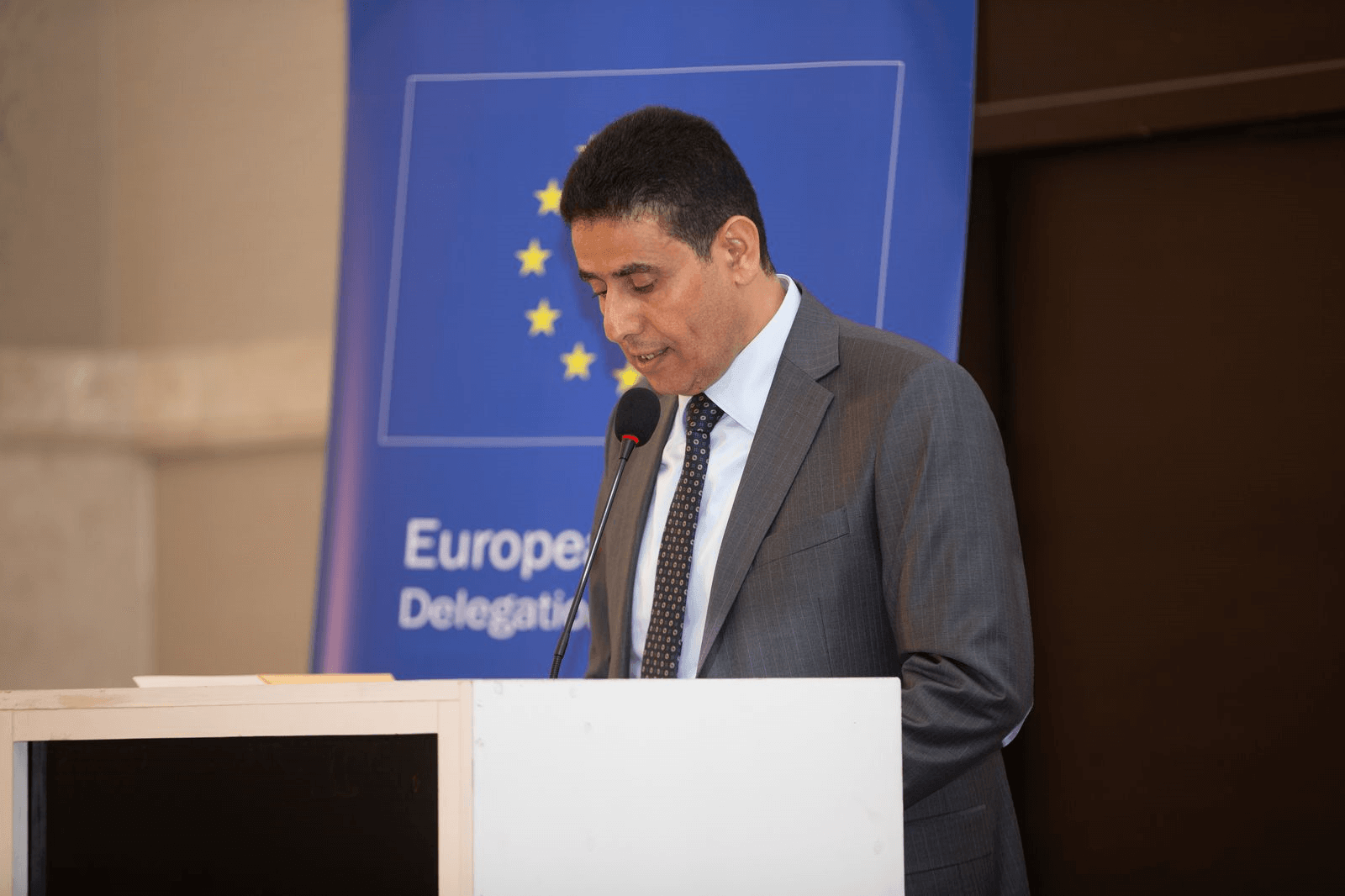
Himyar Abdulmoghni
UNFPA Representative in Jordan
Opening remarks on the occasion of the
Launching of the National Awareness Campaign
“Her Life without Violence, Her Future without Fear”
“No Silence, No Tolerance” for Violence Against Women and Girls
by
Himyar Abdulmoghni
UNFPA Representative in Jordan
Monday, April 7th, 2025 – Amman
Ladies and Gentlemen,
It is my great pleasure and honor to join you today in the launch of the third awareness campaign, led by the Euromed Feminist Initiative (EFI-IFE), under the project "Enhancing Access to Comprehensive Services Related to Gender-Based Violence in Jordan," funded by the European Union and implemented by the Spanish Agency for International Development Cooperation, in partnership with UNFPA, under the slogan "Her Life Free from Violence, Her Future Free from Fear."
I am delighted to see that this campaign reflects one of the key recommendations of the national study on the economic cost of violence against women and girls, which was completed last year by UNFPA in collaboration with the National Women’s Commission. The study revealed that investment in prevention, awareness, and policy support constitutes only 5.2% of the total cost of response, and recommended directing investments toward prevention to address the root causes and change the attitudes and behaviors that perpetuate violence.
This campaign will also highlight real success stories of women who have managed to break the cycle of violence thanks to the support and essential services they received. In this context, I would like to refer to the study conducted by UNFPA in collaboration with the Spanish Agency for International Development Cooperation, which explored the obstacles faced by survivors in accessing gender-based violence services. The findings show that hearing success stories from other survivors is a strong motivator for women to seek help and access necessary services. These stories inspire and offer hope, thereby enhancing the culture of seeking support and assistance.
Ladies and Gentlemen,
Raising awareness about available services and the different ways to access support is a crucial element in encouraging women to take the step toward seeking help. Here, we cannot overlook the tremendous efforts being made by the Jordanian government, in partnership with national bodies and local institutions, to develop effective mechanisms for prevention, protection, and response to violence.
Studies have documented the outcomes of these unified efforts. The 2023 Population and Family Health Survey indicates an improvement in help-seeking behavior among survivors of violence, with the percentage rising to 34% compared to 19% in 2017-2018. This improvement is attributed to institutional interventions that have contributed to enhancing the support environment available to survivors.
Despite the improvement we have witnessed in help-seeking behavior from women survivors of violence, we cannot ignore the percentage that still prefers silence or fears asking for help. As the Population and Family Health Survey indicates, 57% of women who have experienced violence have not sought any form of help, a figure that reflects the challenges we face in this area. This large percentage points to several obstacles standing in the way of women, such as fear of stigma, concerns about lack of protection, or even a loss of trust in the effectiveness of the system that is meant to support them. These statistics emphasize the urgent need to intensify efforts to create a safe environment that supports women and builds their confidence in seeking help.
The slogan of the campaign, “Her Life Free from Violence, Her Future Free from Fear,” represents a vision for a better future. We believe that we can build a society where women and girls are given the opportunity to achieve a future free from violence and fear, where everyone lives in safety and dignity. We will all work together toward a future in which gender-based violence is eradicated, and equal opportunities are provided for every woman and girl to achieve her dreams and aspirations.
In light of the current challenges, UNFPA is adopting an approach focused on sustainability in its programs, which helps us adapt to changes and ensure the continuity of effective support. This approach reflects our commitment to finding innovative solutions to address the reduction of some funding sources allocated to vital programs, aiming to ensure the provision of necessary services to survivors of violence. In this context, we have built strategic partnerships with several ministries and governmental bodies, including the Ministry of Social Development. We are proud to announce these partnerships, which aim to improve the services provided to survivors of gender-based violence. We believe that the fruits of this collaboration will not only positively impact individuals but will also contribute to the advancement of society as a whole, reinforcing the development agenda in Jordan within the framework of the country’s economic modernization vision.
In conclusion, I would like to express our sincere appreciation and gratitude to the European Union and the Spanish Agency for International Development Cooperation for their generous support, as well as to all our partners in this project for their commitment and dedication.
Together, we can bring about the change we seek. Let us continue working hand in hand to build a future free from violence against women and girls, where prevention and protection are effective, and where access to services is a guaranteed right for all, not just a privilege.
Thank you.
Profile
Himyar Abdulmoghni is a humanitarian and development professional with over 20 years of leadership experience across government, private sector, NGOs, INGOs, and the UN. He has served with UNFPA in Yemen, Jordan, Zambia, Iraq, Equatorial Guinea, and Syria, holding roles such as Assistant Representative, Programme Coordinator, Deputy Representative, and Acting Representative.
He holds an MBA from Open University Malaysia, a diploma in Social Sciences from Costa Rica University, and a B.Sc. in Pharmacy from Sana'a University.
Mr. Abdulmoghni has led large-scale programmes on reproductive health, gender, and population and development. He is a strong advocate for human rights and the ICPD agenda, with expertise in results-based management, evidence-based advocacy, national capacity building, and resource mobilization.
He assumed his role as UNFPA Resident Representative in Jordan in August 2023. He speaks Arabic and English.